

Object permanence
Your panic will always outpace you.

It happened some time in December. It must have been earlier in the month, daylight still being chipped away at by cold nights growing longer, not yet on the other side of the winter solstice.
I’m not sure how long my text messages had been gone—two weeks, maybe three?—by the time I noticed. It was the same feeling I had when they tore down the arena in downtown Austin to make space for the new cancer hospital—the arena I graduated high school in, that sat across the street from the university I floated in and out of for 8 years, a stone’s throw away from where my parents moved after selling our childhood home. For weeks, I drove past the disassembling. First, the concrete exterior was removed—slowly, over time, whittled down to piers and beams, its skeleton exposed by a city rapidly changing. And then, one day as I stared out the passenger side window, driving home from the Sunday morning farmers’ market, I realized it was totally gone, reduced to a pile of rubble. It had been gone for days at that point, my eyes only then catching up, bringing the loss into view.
When I first noticed my messages had been erased, when I had gone back to retrieve a friend’s address only to find no text message older than 30 days now existed within my phone, I had a feeling similar to when you stumble off a curb, one of momentary disorientation. Despite growing up a neurotically neat and organized person, I am a memory packrat, toting around boxes of photographs and letters and notes—passed in middle school and high school—from dorm to apartment to home throughout my adult life. I have stacks of printed out emails held together in three-ring binders and a 15-gallon box wedged in the top of my office closet, filled to the brim with journals. I tried to regain my balance, find my bearings.
The magnitude of it didn’t sink in until a couple of days before the New Year. I was walking through my kitchen, hair curling outward and upward, still unshowered late into the morning as time suspended and normal routines were forgone during the week between Christmas and New Year’s Day. I stopped between the island with the butcher block counter and the buffet stained a deep mahogany, frozen. I knew the day marked two years since my friend’s death, her memory had followed me throughout the house like a ghost from the moment I awoke. But as I thought of the last message I received from her number, her sister reaching out to inform me of her passing overnight, I felt my stomach lurch toward my throat, knowing I could never again read it back.
My husband walked out of the living room, toward the kitchen table, his pace slowing as he neared me. I swallowed, eyes meeting his in panic.
“I lost all of my text messages,” I told him, voice croaking.
He nodded, waiting for me to draw the line between the pain illustrated on my face and something as seemingly innocuous as a technological issue.
“My friend that died,” I continued. “I lost all of our messages.”
He pulled me in for a hug.
“There was a voice note in there.” My arms fell to my side. I let him pull me closer, my body stiffened with grief. “I can’t hear her voice anymore.”
It wasn’t until after the death of my grandfather, in late February 2022, that I began to save voicemails. One day I realized I couldn’t quite remember his voice as I’d heard it so many times on the other end of the receiver, thick with a West Texas twang, phone calls always ended with a “Buh-bye, honey. I love you.” I replayed it in my head, trying to locate the correct downbeat in the syllables, trying to remember how his drawl elongated every word into its own sentence. Time had changed it, erased it bit by bit. The harder I tried to hold on, the more distorted his voice became.
I began to memorialize people while they were still living. I tucked away notes from friends, hesitated a little longer before our annual purge of holiday cards stuck to the sides of our refrigerator with mismatched magnets. I turned voicemails from my father into mp3s, moved onto the Cloud for safekeeping, backed up onto hard drives just in case. I saved postcards from my mother that arrived like clockwork two weeks after a family gathering, her handwriting creeping up the margins, out of space, thanking my husband and I for attending. I might want these someday, I told myself.
I did not pack these items away with the same fondness felt before, as I did in my youth. I packed these items away with a warped sense of premonition—memories of those I loved entombed in a plastic bin purchased at The Container Store, sloppily labeled “Kate’s Memory Box.” With each item and each note and each voicemail, I hedged a bet, anticipating its value would increase exponentially with time, afraid to let anything pass by, afraid to let anything go. It is not a smart way to play the stock market.
When the fires broke out in Los Angeles in early January, swallowing up neighborhoods whole, reducing lifetimes of memories to char and ash, I began to move through our home with a frenetic energy. I catalogued artwork and knickknacks and keepsakes in my mind, ranking them in terms of importance, of value, of their irreplaceability.
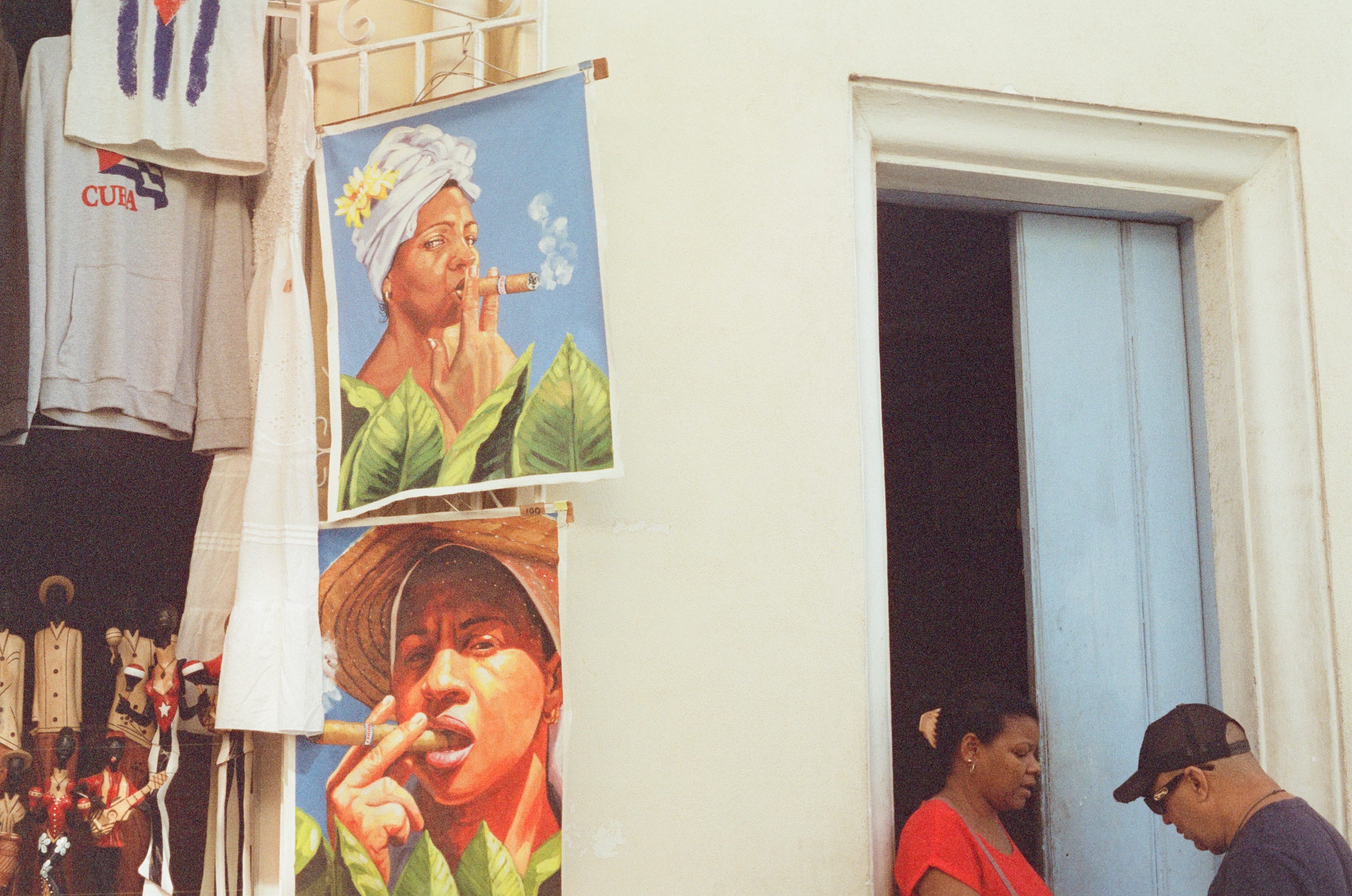
One evening, sitting at our normal spots in the living room—my husband on the green, tufted couch with threads of white and golden dog hair woven into the fabric, and me on the leather armchair tucked between the record console and upright piano, the one our cat peed on a couple of months before she left this world—I stared directly into the eyes of the painting I brought home from Cuba, canvas stretched tight behind its black frame, purchased on the streets of Havana. It’d be sad to lose, but not important enough to save, I ranked it in my mind.
I turned toward my husband. “What would you take from our home? What would be in your go bag?”
Without looking up from his newspaper, he said, “Annie, obviously.”
I tried to blink away the thought of our house engulfed in flames, our dog inside and unable to escape. “That doesn’t count,” I told him. “Of course we’d take her.”
He began to rattle off important documents and the contents of a weekender bag—a couple of shirts, a few pairs of jeans, enough underwear to last weeks—when I stopped him again, told him he wasn’t understanding. I felt the panic clawing its way through my body as I sat in the middle of a lion’s den of memories threatening to one day be lost.
This game felt similar to one I played as a child. I developed a new ritual of making escape plans after the local firefighters had come to my elementary school to teach us to stop, drop, and roll. They brought a trailer with them meant to simulate a house fire. Lost in the group of 4th graders, I army crawled beneath the fog machine smoke that smelled sweet, almost faintly of my father’s Sunday morning waffles, the heat cranked as high as the trailer would allow. I wondered if my first-floor window was too high to jump out of at home. On a loop I began to imagine packing a bag—my journal, my favorite pair of Limited Too jeans, letters from friends I saved while at overnight camp—and kicking the screen off my window before jumping to safety.
The game was one I’d never win, the contents of my bag ever changing, ever growing. Playing it on a loop became almost prayerlike, a Hail Mary muttered underneath my breath, as if I could stave off what I feared most and knew I could not avoid: the pain of loss.
Two weeks ago, my husband and I drove south down the freeway, turning east onto a country road as the sun set behind us, a pot of split pea soup still warm in my lap. In my grandma’s kitchen, we poured ourselves freshly made iced tea while my grandma worried out loud that it hadn’t been brewed strong enough. As I sliced the baguette with a serrated knife so dulled it was barely indistinguishable from a butter knife, my grandma rummaged through drawers before disappearing into the back half of the house. When she emerged, she held a black jewelry box not much larger than a Zippo lighter.
“I knew I wanted to give it to you,” she said, opening the box to reveal a necklace, “but I just figured I’d do it now, because, you know, some of those things don’t end up making it to the people that you want it to.”
I felt the panic begin to claw its way back up; I knew she meant after she was gone. I gently lifted the gold chain, barely thicker than a thread of twine and twice as fragile, to find a nickel-sized horseshoe encrusted in diamonds.
“It’s beautiful,” I told her. I smiled as big as I could to will back the tears I could feel hot in the back of my throat. “I’ve been looking for a horseshoe necklace for years.”
She clapped her hands in delight. “It was a gift to me from your Papa, right when we moved to Seguin.” The necklace had to be at least 50 years old.
I pulled her in for a hug, nearly resting my head on top of hers, my shoes exacerbating our already existing height difference. The gift, of course, was the necklace, but it was also the reminder of how the act of letting go can allow us more peace than holding on.
There’s a line in Steven Daldry’s film The Hours (adapted from Michael Cunningham’s novel) where Virginia Woolf—played by Nicole Kidman in a prosthetic nose—and her husband, Leonard, are sitting in the darkness of their home, illuminated only by the fire cracking between them. Leonard asks Virginia why someone must die in her novel. She pauses, thinking, before telling him, “Someone has to die in order that the rest of us should value life more. It’s contrast.”
My text messages existed in the banality of everyday life until they were gone. And yet, it could not have existed any other way. Without its loss, I could not long for its presence. Something ordinary becomes extraordinary only in its wake.
It’s the double bind we find ourselves in as humans: a resource is only precious because it is limited. Our relationships feel meaningful because we aren’t guaranteed forever. What we do in our life matters because time is finite. No amount of trying to outrun reality will change the fact that humans are a mortal, imperfect creature. If I keep running, my panic will always outpace me.
It’s a coexistence we must learn: knowing that in order for something to matter, in order for something to be meaningful, we must accept that someday we may feel the pain of its absence. Trying to avoid that risk doesn’t much help us to avoid pain, rather it blossoms into a different kind—one in which we live a life void of what makes this brief existence bearable.
Most days, I wear the horseshoe around my neck. For now, I’ve stopped cataloguing the items in my home. I no longer save voicemails, though I still consider it. Recently, I leaned over to my husband in a movie theater, whispered something insignificant about the trailer onscreen, and thought, “That was just like my mother.” It made me cry when I retold that in therapy, anticipating that those moments would be how I remembered her once she was gone. The urge to run briefly flickers.
It’s where I’m learning to live: in the understanding that love and meaning do not exist without loss, in the contrast.
Kate- as always, beautiful.
I relate to so much.